Kendrick’s time-traveling mouse experiment
The Time Traveler's WifeDr. David Kendrick’s time-traveling mouse experiment turns Henry’s involuntary condition from a personal mystery into a laboratory result, while showing that the biological mechanism is not easily controlled. A mouse disappears during a demonstration, but the successful result comes after altered embryos travel out of and back into their mothers’ wombs, killing the mothers or ending the pregnancies. For Clare and Henry, the experiment offers both evidence and a troubling parallel to their own repeated difficulties conceiving.
The demonstration
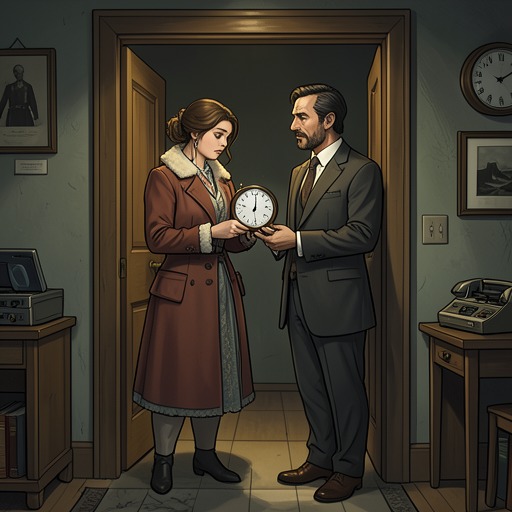
On January 14, 2000, Kendrick brings Clare and Henry into a windowless conference room and dims the lights. A cart holds a covered cage; inside are ordinary supplies, including food bowls, a water bottle, an exercise wheel, cedar chips, and a toilet-paper core. Kendrick takes out a small white mouse and flashes a penlight over it. The mouse tenses and vanishes. Clare watches, still struggling to believe that Kendrick has achieved what he set out to do.
The demonstration gives visible form to a condition that had previously been known chiefly through Henry’s experience. Its restrained, almost routine laboratory setting contrasts with the extraordinary result: a small animal disappears in front of them, not through accident or anecdote but as the outcome of deliberate research.
Genetic method and cost
Kendrick explains that researchers used information from the mouse genome to locate four genes they were targeting. They cloned Henry’s genes, used enzymes to remove damaged portions of DNA, and introduced the pieces into mouse embryos at the four-cell stage. The genetic alteration was only part of the problem. The team struggled to bring the altered embryos to term because the mother mice repeatedly died or lost their pregnancies.
Watching the mice around the clock revealed why: the embryos traveled out of their mothers’ wombs and then back in, causing internal bleeding, or were aborted at ten days. The experiment thus reproduced time displacement alongside a grave reproductive hazard. When Clare says that she and Henry can relate to the problem, the remark connects laboratory observation to their private history of trying to have a child and experiencing pregnancy loss.
Consequences for Clare and Henry
After returning home, Clare contacts Dr. Montague and discusses immunosuppressants and internal bleeding. Montague listens, agrees to research the matter, and asks Clare to come in the following week. Clare tells Henry that trying is worthwhile; Henry replies that many mouse mothers died before the researchers solved the problem. Their exchange leaves the possibility open without disguising its cost: the experiment offers a route for investigation, not assurance of a safe outcome.
That uncertainty belongs to a larger family decision. Clare and Henry had begun trying for a baby while Clare feared that Henry’s time-travel difficulties might be hereditary or interfere with pregnancy. Henry later decides to have a vasectomy, yet Clare becomes pregnant because an encounter that occurred years earlier for Henry remains recent for her. The mouse experiment therefore does not stand apart from their lives as a purely scientific episode. It sharpens the tension between their desire for a child and the risks they associate with inheritance and pregnancy.
Significance
The experiment’s achievement is double-edged: it shows that the genetic basis of time displacement can be investigated, while its failed pregnancies make the cost of intervention impossible to ignore. For Clare and Henry, the mouse is at once evidence that the condition has a biological basis and a warning that the mechanisms involved may affect reproduction in ways they cannot control. The demonstration opens a possible path toward understanding the condition, but it cannot promise that understanding will make family life safer or more predictable.
The scene also alters the scale of the problem. What had belonged to Henry’s body becomes a question of genes, embryos, maternal risk, and the next generation. In the context of their efforts to conceive, the experiment’s vanishing mouse is not simply proof of a scientific feat: it makes the possibility of inheritance tangible while leaving its consequences unresolved.